"Some have relied on what they knew/Others on being simply true." ~ Robert Frost
Wednesday, June 26, 2024
Who Is Matt Eicheldinger and Why Does He Make Me Cry Every Day?
Friday, October 13, 2023
How Books Are Made, Part II
In
my previous post, I talked about the creativity that goes into the
making of a book. But I didn’t talk about the practical side of bringing that
creative spark into fruition (if you’ll allow the mixed metaphor there).
It’s one thing to have an idea for a book. It’s an entirely different matter to spend hours at a keyboard (or with pen or pencil and paper), day after day, week after week, month after month until that original idea has been fleshed out into a story with a beginning, a middle, and an end, hopefully containing some tension and conflict throughout, and a resolution that satisfies the reader—plus maybe, just maybe, giving readers something to “take away,” a lesson to ruminate upon or a miniscule bit of wisdom that might, in the tiniest way, influence their choices for the better. One hopes.
When I began the Dragon Singer Series, I was still teaching, so my writing time—after being away from home all day, then returning to walk an anxious, troubled dog, and feed the cats, and eat dinner, and watch the news, and maybe toss in a load of laundry—was limited. In addition to that, I began Fey Girl, the first book, in pencil, writing in a composition book that my granddaughter, Ellie, had given me. I wanted to channel my inner ten-year-old, and I remembered writing some stories in a composition book when I was that age—some of my first! And so I began.
The
process was interrupted often. Given my schedule (rising at 4:00a.m. to get to
the gym before work or to ride my bike to work and arrive at 6:45), I was tired
by early evening. Things happened. I had house guests. I came down with
pneumonia a few times. I struggled through winter depression.
Finally,
in June of 2016, I retired from teaching. In that summer, I sold a house,
bought a house, moved 40 miles east—and slept as often as I felt like it. Then,
at long last, I joyfully returned to my writing life in earnest.
As
soon as Fey Girl was finished, I began writing the second book, making
steady progress and finishing it within a year. The third book took less than a
year. The fourth, even less than that. While I was working on Book Two, my dear
friends John and Lisa Durham introduced me to John’s niece, Annie Katz, a
writer and novelist and earth mother who became my best and truest critique
partner. We began exchanging projects, giving each other feedback, and engaging
in long phone conversations about the best way to publish. She is all about independent
publishing. Another friend believes one is not a “professional” writer until
one has been published by a traditional publisher. (Well, I’ve done that, so….)
In
a nutshell, here’s the difference:
A
traditional publisher takes the author’s manuscript and has a team of printing
experts design an interior (choosing the type of font, the type of paper—weight
and color, the margin size, the spacing between lines, as so forth). Another
team of experts designs the cover. (Will the title be larger than the author’s
name? Yes, if it’s a first-time author, no, if the author is Stephen King. What
will the balance of text-to-graphics be? What colors will work best?) While this
process is happening, the publisher may decide—based on “marketability”—to change
the book’s title. Or add a subtitle. Or edit—or delete—some of the content. But
hey, when the book is finally ready (one to two years after acceptance), it
will be released across the country simultaneously, available online but also
on bookstore shelves, all at once, all on the same day.
An
indie author can’t do this, since the big bookstore chains (well, I guess there’s
only one left, isn’t there?) will not carry (unless asked by customers)
independent authors on their shelves. Nor do indie authors have the opportunity
to list their books in the lovely, slick catalogs that publishers send out to
bookstores.
However—independent
authors have full control over every aspect of how their books are published,
from interior design to cover design, and we even determine the list price.
This
is why I made the choice to publish the Dragon Singer Series
independently. The more I spoke to Annie Katz and others (including my buddy,
writer/actor/director/funny guy Tim Chizmar), the more reluctant I became to
give up creative control. I had a vision for these books, and I couldn’t bear
the thought of being told, “We’ve decided to add/subtract/edit…” or whatever a
marketing department might choose for MY books. (For the purpose of brevity, I
will not include all the struggles I had to this end with the publishers of my
first and second books. If you’re curious, just ask in the comments below. But…
boy howdy….)
Of
course, in making that crucial decision to self-publish, this also means that
the entire process rests in the hands of the writer (unless one chooses to
outsource the work, which is possible, but also expensive).
The
only thing I didn’t do was create the illustration and design for the covers.
(Thank you, artist-designer Allie Myers!) Everything else—fonts, font size,
paper, margins, interior design—that’s all me. And believe me, it’s not a
matter of “select all” on MSWord and typing in a few choices. There is a lot to
very carefully complete. Plus don’t even get me started on how the format of an
“ebook” differs from the format of a paperback. Good grief!
So,
yeah, even though the fourth and final book in the Dragon Singer Series
was completed months ago, it has taken me quite a number of weeks to find an
illustrator and work on the interior design.
Finally,
though, the first book is finished, and I am so, so proud of it! Allie’s cover
is beautiful, and I am satisfied that my young (and older) readers will feel
comfortable with my choices for the interior design—if they’re even paying
attention. Maybe they’ll just immerse themselves in the story and keep turning
those pretty white pages….
Fey Girl, Book One in the Dragon Singer Series, is set to be released at 12:01a.m. on Tuesday, October 17. Please celebrate with me on that day! If you get crazy (or extraordinarily kind) and decide to read the first book, just know that Allie and I are already working hard to get the second book ready for publication. This one should be easier than the first; I kinda know what I’m doing now. Kinda….
Tuesday, October 3, 2023
How Books Are Made, Part I
It
starts with a spark of creativity, a tiny seed of an idea that begins to take
root and grow in a writer’s brain. At first, it’s easy to ignore the tender
little seedling trying to find purchase in a place already teeming with ideas.
Those initial ideas definitely get overshadowed by projects that have already
made it from brain to keyboard (or yellow pad or sketchbook, in my case). I can
pretty much guarantee that the majority of working writers have at least a
dozen ideas growing in addition to the three or four projects they’re working
on. I do.
Take
this post, for instance. The initial idea formed about a month ago. In that
time, I have jotted notes for the next blog post (and the one after that),
finished and submitted three poems for publication, revised and submitted an
essay for publication, worked my tail off to format a book for publication
(more on that in the next post), and written countless journal pages. That’s
just the physical work I’ve put in. The extra ideas that haven’t been harvested
yet? They’re still growing in my brain. Some of them are really getting out of
control in there….
It
still amazes me to think how my published books came into being. In the 1970’s,
I was teaching Lamaze childbirth classes, and my students felt the available
books were too technical. I was freelancing at the time, miraculously getting
published on a regular basis, and they suggested I write a book with all the
information I dispensed in class, posed in less clinical terms than others had
used. I gave it some thought (and growth time), and two years later my first
book was published.
When
I began researching, at my mother’s request, the alleged crimes of her
grandmother, I knew eventually I had enough material for a pretty compelling
memoir. Many years later (when Mom would finally allow it), The Tainted Legacy of Bertha Gifford came into fruition.
The Dogs Who Saved Me came about during a long summer afternoon spent
organizing photographs. I had so many pictures of the various dogs I have
companioned with, I realized there were enough to make an album of just dogs
alone, and as I leafed through the finished project, considering all their
incredible stories, I knew I wanted to record them. That book took two years to
write.
This
next book—the one that I am just weeks away from seeing released on Amazon—did
not begin as a book idea or even a writing project. It began as a song. No. It
began with a cat that looked like a dragon. Or more accurately, a dragon that
looked like a cat. Here is that story:
When
I moved waaaay up to a cabin in the mountains, I took two black cats with me:
Old guy Boo Radley and newly adopted Sugar Plum (aka “Sug”). Sadly, in my
second year on the mountain, Boo died. Where Sug had previously bonded with
Boo, now she began to bond with me in earnest. And it was cold in the winter
months, so she would come to the loft at night, jump on the bed, and I would
hold the blanket up for her to climb under and snuggle down. Often, in the
depth of darkness and quiet only a mountain retreat can offer, I would sing to
her. In the beginning, I sang her “Too Ra Loo Ra Loo Ral” and other sweet Irish
songs I had learned as a child.
Then
several things happened in succession. My dear friend and fellow author Michael
Welker (Blockbuster Blueprint) suggested I watch the animated feature
How to Train Your Dragon, mostly because he thought I’d love the soundtrack,
which I did. (Loved the film, too; ya gotta love a rescued
critter/underdog/unlikely love story/unlikely hero movie.) Sometime in the
ensuing days, I walked into the main room of the cabin to find little Sug face
to face at the French doors with an enormous black bear. Sug was standing her
ground, back arched, fur and tail puffed to maximum bigness, and hissing as she
bared her teeth. She looked, in that moment, for all the world like a tiny
dragon. Later that night, as we hunkered down in bed, I began to hum a random
tune I’d come up with. Suddenly there were words for it:
Dragon
song is an old one
Sing
the tale told so long
Dragon song is an old one
Old one, sing the dragon song.
At
some point before this, I had attended a writers group meeting in which the
guest speaker had noted, in suggesting ways to market one’s books, that the
creation of a series (rather than a stand-alone novel) brings readers back
looking for the next chapter in the saga. I had dismissed the idea at first.
(Writing a series—keeping every detail of every character and plot point clear
and correct throughout all the books—is much more challenging than writing a
single, all-encompassing story.)
But
that night, singing this new song to my tiny cat who apparently had the spirit
of a dragon abiding within her, a seed was planted.
Hard
to believe that seed began to take root over a decade ago. Well, the original
idea became a book. (More on how that happened in the next post.)
Originally, I had decided just three books—a compact trilogy—would do nicely.
(No way would I attempt an on-going series, given all the other projects I want
to tackle.) But as I worked on the second book, I realized that the four
seasons had become a theme, so that now there are four books in what will be,
when they are published, the Dragon Singer series. The books are written
for a middle-grade audience. Which means, I suppose, that any avid reader over
the age of say, eight, who loves cats and good dogs and dragons and music will
probably enjoy them.
Did
I mention that the first one is nearly ready for release in a matter of weeks,
if not days? Watch this space!
Wednesday, January 12, 2022
Books in 2021
Some
years ago, I began the habit of stacking up books in my to-read pile as autumn
approaches. I hate the short days, when I can’t be outside as much, but if I
have a book to look forward to reading, the long evening hours are well spent.
Here are a handful of books I’ve read in recent months that I absolutely loved.
Beautiful Ruins, Jess Walter
In
a casual conversation, a somewhat happy-go-lucky friend mentioned that he had
just finished reading a book that made him cry.
“What
the heck? Really?” I queried. “What book was that?”
“Beautiful
Ruins,” he responded. “Have you read it?”
“No,” I replied, “but I’m about to.” I downloaded it to my Kindle and started reading it that night. Why did I love it? For the characters. All of them, and there are many, therefore multiple points of view, but that is never off-putting to me. I want to hear everyone’s side of the story.
The
Lincoln Highway, Amor Towles
This novel was also recommended by a friend who loves books and knows me well. It is similar to Beautiful Ruins in that there are multiple points of view, and most of the characters are easy to love, easy to sympathize with. The setting of this novel could have taken place in current times, but I’m so glad Amor Towles chose to set it in the 1950’s, the decade of my childhood. The writing is lovely, the characters so memorable and the book so long, a reader will genuinely miss them for days after finishing the book. I still do….
Project
Hail Mary,
Andy Weir
This novel is science fiction. But keep in mind, there is classic sci-fi, and then there are books like A Hitchhiker’s Guide to the Galaxy. Project Hail Mary isn’t quite Hitchhiker’s Guide, but it’s also definitely not Dune or The Martian Chronicles. Andy Weir, by the way, is the guy who wrote the novel The Martian, upon which the movie starring Matt Damon was based. I didn’t read that one. I only read Project Hail Mary because a friend sent it to me with a note saying “Trust me. Just start reading.” So I did, standing over my kitchen table, the cat still playing with the shipping debris. I read the first 20 pages that way, then made some lunch and sat down and read another 30, then realized the entire day was whiling away as I read this quirky, funny, harrowing, charming novel. I finished it in a matter of days (despite its length at 496 pages), then wrapped it up and sent it to a friend with a note that said, “Trust me. Just start reading….” He loved it so much he called me from Texas when he’d finished it. Our two-person book club spent an hour and a half talking about it. (Just to mention here: I rarely read sci-fi anymore, but I re-read Dune in the summer of 2021 because the absolutely fabulous film was set to air months later. Loved Dune even more the second time ‘round.)
A
Valley of Light and Shadow: Las Vegas Writers on Good and Evil
In between novels, I read through the essays and memoir pieces in this anthology. The book is published in collaboration with the Las Vegas Book Festival, and it highlights the writing of authors who live or have lived in Sin City. In a conversation with my friend, the multi-talented Tim Chizmar, he mentioned he’d written an essay for the current volume. Since the proceeds of the book support writers, I bought a copy on Amazon, expecting to read a few essays about how, ‘Yeah, it’s hot here and there aren’t a lot of jobs besides working in the casinos.’ This book is definitely not that, and Tim’s essay was so compelling—about the profound life changes he went through over the course of a five-year period, how he hit rock bottom—then discovered he was headed for whatever was below rock bottom—then somehow survived, learned, grew, flourished and became successful all over again—well, it made me cry and applaud in equal measure. I highly recommend this book for lovers of human interest stories and also for my fellow writers; there are fine examples of the personal essay and memoir writing here, and money spent on the book will help support their craft.
The
Sweetness of Water, Nathan Harris
Where do I begin? The sweetness of his words, the sweetness of his characters, the agony and sweetness of a time in our history…a time that somehow seems to keep repeating itself. This book is lovely in a thousand ways. I understand why Oprah snagged it for her book club, why Barack Obama said it was one of his favorite books of 2021. I’m right there with ya, Mr. President. If you love writers who can magically craft a sentence that stops you in your tracks for the sheer beauty of it—like a gorgeous sunset or the unexpected sighting of a wild animal—read this book. Then come weep with me.
Daughter
of the Morning Star, Craig Johnson
Speaking
of beautiful craftsmanship in writing, please never pigeon-hole Craig Johnson
as simply a “mystery” writer or a writer of “Western” novels. The Longmire
series definitely has a contemporary Western flavor, and each book has a
stand-alone, mostly who-done-it mystery to be solved. But this series isn’t
just beef & barbecue. It is rich in many sophisticated flavors as well. I
began reading the Longmire series some years ago, based on the recommendation
of a friend whom I trust—otherwise, I probably would have passed, assuming that
the novels were gratuitous-violence-heavy and formulaic. No, in fact, they are
not, and this was a delightful discovery. In fact, from the first pages of the
first book, I was surprised and delighted by the extent of Craig Johnson’s expansive
lexicon, his sensitive treatment of all things Native, and his extraordinary
ability to weave a compelling story. I’ve read all the books up to this most recent
one, but Daughter of the Morning Star is absolutely my favorite. Here’s why: In
it, Johnson deals with a harrowing and heartbreaking truth, one that is
astounding in its scope but shameful in its lack of coverage by the popular
press. It is this: The suicide rate for Native teenagers is two and a half
times greater than the national average, and the murder rate for Native women
is ten times the national average. Every year, Native women go missing at a horrifying
rate, but these cases rarely make the news. In Daughter of the Morning Star,
Johnson dishes out these statistics unapologetically as he draws us into the
life of Jaya One Moon, a rising high school basketball star. Native culture and
beliefs are woven in with sensitivity (not appropriated), and we see in Jaya a
woman whose great strength is no match for the dark forces that threaten
her. Still, she perseveres. Another reader characterized this novel as
haunting. It is exactly that. Hauntingly beautiful in its realism.
Sunday, July 26, 2020
Books, Part Two: Finding the Shadow of the Wind
Sunday, July 19, 2020
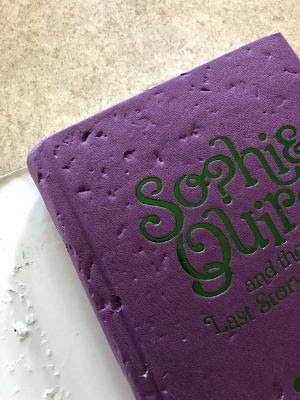
Books, Part One: Rescuing Sophie Quire
Saturday, March 11, 2017
When lilacs....
Monday, February 15, 2016
Sustenance
Monday, December 30, 2013
How Purrl made it work
Tuesday, December 24, 2013
Under the apple boughs
Thursday, August 30, 2012
Why this author is giving away free books
The first time I noticed an author doing a "giveaway" on Goodreads, I have to confess, I was kind of resentful. As it turned out, I had just finished reading that same novel--a book I'd spent a few dollars of my exiguous fortune on--and now here was the author just giving it away for free. "Hey, I'm a teacher living on a single, limited income that keeps shrinking! Give me that book!" is what I thought at the time. But then... I looked into what the giveaways are all about, and I finally understood. For Indie and DIY authors, offering a book or two for free in a giveaway provides an opportunity to let a whole lot more folks know about the book.
In my case, with The Dogs Who Saved Me, I was reluctant to do a giveaway, because 100% of the profits from this book are being donated to animal rescue groups, and I didn't want to take one penny away from that. However... after a conversation with Indie marketing guru Martin Lastrapes (who just happens to be my favorite Indie author), I realized that by offering a couple of copies of Dogs for free, I could generate more interest in the book, which would generate more revenue for a local rescue group (HOPE rescue in Upland, CA), so I jumped on board.
I am pleased to say that there are currently 500+ readers who have entered the giveaway. Even more exciting is the fact that 72 readers on Goodreads have added the book to their "to read" lists, and several have sent me messages to say that if they don't 'win' the book, they will buy it right away as they find the premise intriguing. Yes! Success! And think about it--if those 72 readers like the book and recommend it to friends, the snowball will continue to grow (hopefully), garnering new readers and more support for the rescue groups that do so much by sheer power of animal love and enthusiasm. Bless them!
So--if you haven't yet read The Dogs Who Saved Me and would like to enter the giveaway, there's still time!! (At this writing, 6 hours and 30 minutes--so get on it!) Click on the link below and enter. There are no strings attached!! You will not be asked to write a review or give a speech or compose a lively verse about the book, nor will I or the great folks at Goodreads save your info and try to strongarm you into buying books... or ocean view property in Missouri.... If you don't have a Goodreads account, consider establishing one, as there are many, many good books available through the giveaways for free, plus great conversations taking place all the time with intelligent readers.
Okay, I'm done yakking. Here's the link:
Goodreads giveaway of The Dogs Who Saved Me
Sunday, July 22, 2012
Books, Dogs and HOPE
I’ve got some great news flashes I’ve been wanting to share with you, Dear Reader, but first let me describe where I am—because I really can’t write a blog post without talking about the mountain. I know you understand….
At the beginning of the summer, I bought an inexpensive HP laptop so that I could do this: I’m sitting in the swing on the front deck. It’s about 3:00 in the afternoon. A light breeze is blowing through the oak tree canopy surrounding the cabin, cooling my skin and mimicking the sound of water rushing over rocks in a faraway stream. Punctuating that sound is the chatter and call of some bluejays, chickadees, wrens, woodpeckers, dark-eyed juncos, a titmouse or two, and something that sounds like a guinea pig making its “week-week-week” sound. Sugie hears them, too. She’s sprawled out in the dappled shade a few feet from the swing pretending to relax, but she is ever-vigilant. Beware, my feathered friends; do not land too close.
So. Part of what has kept me busy in recent weeks has been writing book reviews. Some writer friends have had books released (hurray!), and summer gives me (too much?) insouciant time to sit as I am now, enjoying the outdoors while turning pages. (It’s okay to be envious; that will all change in winter when it’s snowing and the swing is packed away in the garage. Of course, then I’ll be sitting in front of the fire….)
Libby Grandy, a long time blogger and Chicken Soup author, has seen the release of her first novel, Desert Soliloquy. I was privileged to read it in manuscript form, but the book had been so diligently edited I really didn’t have much of a critique to make. I love a good mystery, and this one is tightly woven. She does not go over the top with red herrings (hate that), but keeps the suspense taut—not only with the mystery of the attempted murder but also with the deeper, perhaps more mysterious question of who the protagonist will choose to spend her life with. Loved it—and hate the fact that Libby has a second novel nearly ready for publication but feels inclined to wait until next summer for its release. But I want to read it nowwwww.
Paula Priamos, also a blogger and a professor of all things literary, just saw the release of her memoir, The Shyster’s Daughter. I’ve been waiting for this book for nearly two years, ever since Paula’s husband, author James Brown (The Los Angeles Diaries), bragged about it at a writers conference. I have to warn you, if you read memoirs because you enjoy reading light-hearted tales told by upbeat people who managed to keep smiling through hard times, better buckle your seatbelt for this one. Priamos’ writing is stark and tight and gripping. And geez, does she ever have a story to tell about growing up in SoCal with her high-profile attorney father, an inappropriate uncle, and other characters guaranteed to ensure a kid’s quick loss of innocence. I had kind of a weird, schizophrenic response to the book as I read it; I’d read a few pages, mutter “oh my god” out loud, put the book down because it reminded me far too much of my own childhood, then pick it up and start reading again. It’s the most compelling memoir I’ve read in years.
Since I’m talking books, please indulge me for a moment. The Kindle version of MartinLastrapes’ book, Inside the Outside, made it all the way to Number One on Amazon’s Horror list a few weeks back. As you may know (because I seem to mention it often), Martin was a student of mine way back when I taught English 1A for Chaffey College. All I said was, “Martin, you could be a writer,” and look what the kid did. Geez….
Finally (and can I have a drum roll here, please?), my memoir, The Dogs Who Saved Me, came out this month. I want to shout “Hurray!” in jubilant celebration… but I think I’m still recovering from writing this book. I was so cavalier two summers ago when I began work on this project. “I’ll just write about my dogs!” I thought. “Easy peasy!” No. This was the most challenging writing task I’ve ever assigned myself. Little did I know how tough it would be to recall those dark adolescent days and other points in my life in which I needed the unconditional love of a dog to sustain me. Now, though, I’m glad I kept trudging through it (with frequent breaks, I kid you not, to simply walk away from the keyboard, out into the forest, to let the tears fall until I could breathe normally again). My intent with this book is to honor the dogs who quite literally saved my life. I think telling their stories does that. But… to honor them further, I’ll be donating all the royalties from this book to animal rescue. The first royalty check will go to HOPE rescue in Upland, California. HOPE is comprised of a tiny crew of amazing and selfless people who work tirelessly to rescue dogs and cats slated for euthanasia or that have been found on the streets. My little Sug was just such a cat, taken in by HOPE, placed in foster care where she was loved and spayed and brought to good health, then made available for adoption. Had she gone to a public shelter, she would never have made it out alive. And what would I do without her? Recently the good folks at HOPE rescued a beautiful Beagle mix puppy from a high-kill shelter and a volunteer is now fostering her. I love these peeps, so every time someone buys a copy of Dogs, I get all happy, because I know that the royalty from that sale will enable HOPE to do just a bit more of the heroic work they do.
So you can see why I’m busy trying to promote this book. I’ve set up some readings/signings, which I’ll be announcing here. I always love doing these events (what author doesn’t?), but they’re especially fun when I know that the end result will enable me to contribute to the fur community. Win! Win! Win!