Showing posts with label singing. Show all posts

Tuesday, January 30, 2018

Madness Dancing

Since mid-November, I have been, er, under the weather. Ill in some way, certainly, but not exactly "sick," as I would characterize it. The week before this malady began, I had some dental work (a crown), and I had a flu shot. Three days after the shot, I woke feeling dizzy, achy and with a mild headache. I took a nap that day—and slept three hours. Despite having slept eight hours the night before, I was still so sleepy after three hours of napping it was all I could do to get up and take Thomas out. It was chilly in the house, but I woke feeling clammy, as if I'd been sweating.

"Dang," I thought, "this is quite the reaction to that damn flu shot. Thank goodness it will go away in a couple of days."

But it didn't. After the symptoms persisted for four weeks (cold sweats, daily dizziness, headaches and a profound need to sleep excessively—rivaling the number of hours I slept when I was pregnant), I made an appointment to see my doctor. By the time I saw her, I'd narrowed my own diagnosis down to either Lyme disease or a brain tumor.

Dr. V. ordered a CT scan, so no, I don't have a brain tumor. I do have a brain that shows "no abnormalities." (Comment on that as you will.)


After a second appointment, here's what I know:

I don't have BPPV (Benign Paroxysmal Positional Vertigo) or at least it doesn't seem so.
This is not a neurological problem—or at least it doesn't seem so.
This is not West Nile Virus—or at least the doc doesn't think so.
It's not got to do with my hypo-thyroidism.
There's no infection in my system, apparently (according to blood tests).
I probably don't have cancer. (Yay!)
I don't need new glasses (as Harry R. suggested).
This probably won't go away if I "relax enough" (as Harry C. suggested).
I'm not dehydrated.
The symptoms worsen dramatically when I don't nap or if I become overly fatigued.

I'm only posting all that so that the sleuths among you can get busy thinking and come to some conclusion that would be a possible diagnosis. (Go ahead. Have at it. Please click on "comments" below to offer your two cents.)

Anyway, my life has gone on unabated—thank the Universe. I'm still walking my dog (though I try not to get too far out in the boonies lest I keel over and Thomas has to find his way home alone), still writing, still feeling blessed for having the ability to sing (but not dance because, yeah, too dizzy).

And today I transplanted a tree. A week ago I mowed the lawn, a chore that hadn't been done in many weeks as I just didn't trust my body with the task. Today I felt good enough (albeit somewhat dizzy) to dig up the orange tree that the previous owner had planted on the shady side of the house. Now it will have more sun and more love and some prayers that it will re-root itself and finally grow some oranges. If nothing else, it will give all my little backyard birds a place to sit while they're taking turns at the feeder.


Since my days of wooziness began, I've had a song off Rick Shea's new album ("The Town Where I Live") stuck in my head: "Trouble Like This." It's a catchy tune, but I think it's been on repeat in my mind because these multiple doctor visits with no resolution remind me of the fall of 2012; it took three months before my bronchiectasis was diagnosed. (And that only happened because I insisted that my doctor order a CT scan of my lungs. "Okay," she said, throwing up her hands, "if that's what you want." Yes, humor me, please. And what do you know? The CT scan revealed the gaps in my lung tissue.)

Rick Shea at a recent concert.

Today, though, my brain worm switched from Rick's song to a song by Bob Bennett, "Madness Dancing," from his "Matters of the Heart" album. Lordy, I love this song! And I have for nearly forty years. Consider these lyrics:

In the middle of this madness I am dancing
Though I'm not sure why just now
I tried to be sober, tried to be logical
But I could not stop my feet.

I know I haven't turned off my mind...
I know there's evil all around
But for now it's outside, and I am in my room
Joy is like a crashing tide.

I don't wanna burn no books
Don't wanna argue rock 'n roll
I don't wanna shoot anyone with my high-powered doctrine gun....

That's pretty non-judgmental for a man who professes to be an evangelical Christian.

At any rate, it's the crashing tide of joy and the madness of dancing despite all the dire woes in life that make me love this song and sing it again and again. Especially right now. I may not be in top form physically, but I am still so blessed to be alive—whether I can dance right now or not.

Saturday, June 24, 2017

Come to think of it, the whole thing started with a guitar


When I was fifteen, my sister taught me to play guitar. I've always said my instrument is my voice, but I needed some accompaniment if I was going to sit around in a circle with my hippie friends and sing "Blowin' in the Wind," so guitar was the best (coolest) option. We went to the swap meet, picked up a nice little folk guitar for 30 bucks (my birthday money), and so it began.

It only takes three chords to play "Blowin' in the Wind," although if you play it in C you have to play an F, and that chord gave me fits until I finally conquered it. Of course, a hundred more songs followed. But, one year later, it was that song, "Blowin' in the Wind," that I was singing the day my eventual husband walked up onto my lawn where I was sitting placidly, playing, singing. We'd never met. He lived in the neighborhood. I'd seen him around. But that day he heard me singing and simply walked up and sat down, listening quietly until I finished.

Six months later, for Christmas, he bought me a guitar. He had told me repeatedly that I needed "a good guitar," a steel string acoustic. Although I had told him I was perfectly content with the guitar I had, as an axe-wielding teenager, I would've loved to have had a Martin (sort of the equivalent, as guitars go, of buying a Landrover). Realistically, given my socio-economic level, I could only dream about owning such a fine instrument. (By the way, "axe" is a euphemism for guitar. The etymology of the term is fascinating, so Google "Why is a guitar called an axe?" sometime just for fun.)

However, on that Christmas Day in 1971, I opened a large cardboard box the size of a small refrigerator to discover a guitar case, and inside that case, a very beautiful guitar. Not a Martin. An Ibanez. Ever heard of it? Neither had I. Now, don't get me wrong. Ibanez makes some really fine guitars, and this one was no exception. But... this was definitely not my dream guitar.

[Quick side note here: Inside that guitar case, in the pick box, was a small jeweler's box. And inside that box was a ring. A thin gold band. "It's a wedding ring!" the man said—in front of my entire family. "Put it on!" That was his proposal. I should have seen monumentally huge red flags unfurling so rapidly they blotted out the gorgeous December-in-Southern-California sun. But I didn't.]

My response to the guitar, I think, was, "Um... ... .... It's nice." I just didn't know what to say. It was huge, a "D" size (no, ladies, guitars don't come in bra cup sizes, though that might've helped), and far too big for me. And it was a "dreadnought" shape (see photos above and below). And it was a light wood, spruce. None of these are characteristics I would have chosen for myself.

And I couldn't play it. At least not yet. No "set-up" had been done on the guitar (sorry for the jargon), so the strings were too high, and they were steel (as opposed to the more forgiving nylon strings I'd learned on), so pushing my fingers down to make chords felt like jamming on razor blades.

"The neck is solid rosewood!" my now-fiancé beamed. He loved that guitar. And what I came to realize is that he bought the guitar that he wanted. No consideration had been given to what I might have wanted (which, no surprise, ended up being a theme in our doomed marriage).

But it was a nice guitar with a beautiful sound, and he had it worked on so that it would be more forgiving on my fingers. So I played it. And played it and played it.

(I'm the one in the middle.)

For forty-five years—at church, in countless weddings, for several funerals, someone's baby shower, several luncheons—I have played that big, loud, sweet-sounding guitar. What a trove of memories we've shared... both good and bad. The good ones involve happy weddings and informal gatherings like my brother's birthday a few years back when he, my sister and I all played our guitars and sang the songs of our youth. Perfect day.


But the bad ones... well, they're pretty bad. Because I mostly sang in church. And I suppose I should mention here that the man I married, the one who bought me that guitar, became the pastor of a church (despite being an atheist when we married). As the pastor's wife, certain things were expected of me. I didn't mind singing; I loved it. But, after eleven years, I just couldn't remain married to... him anymore. (For a list of all the adjectives I just deleted in reference to him, you'll have to private message me.) I separated from him, and when I did, I was asked to leave that church. I went anyway (when he wasn't there), and when I showed up, I was escorted out by deacons and told not to come back. In the years following, while my children and I lived at the poverty level (because their father refused to pay one dime of child support, and he never did), there wasn't much time for singing or song writing or guitar playing while I hustled and struggled to raise four kids on my own, make ends meet, attend college classes, and try to make sense of what had happened. And frankly, I was so grief-stricken over my failed marriage and the treatment I received by the people I thought were my friends, I didn't much feel like singing anyway.

Eventually I began again, picking up the guitar every once in awhile, singing for special events on occasion. But every time I pulled that guitar out of the case, I drew out a swath of bad memories a mile wide along with it.

What to do?

You know, I'm here to tell ya, life is tough. We often wish we had a reset button to enable a do-over, but really, when you knock over hurdles in the race, you don't get to go back, set them back up, and try again. You just have to keep moving forward as best you can.

Having said that, though, I will say this: I accept that I cannot fulfill all my life's longings. I'm resigned to the fact (now, finally) that I'll probably never marry Robert Redford. Sigh.... I won't get that interview with Oprah about my great-grandmother. But damn it, I'm not ready to stop singing. In fact, now that I've retired from teaching, I find myself singing quite a bit.

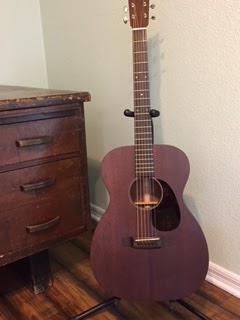
Which is why I bought a new guitar last week (at The Fret House in Covina). It's a Martin 00-15 mahogany beauty with tones so deep and resonant it nearly makes me cry when I play it. I spent weeks researching what I wanted, and with the help of a few old friends and some really cool new ones (thank you, Doug, Tom, Rick and Jorge!), I bought the guitar I've wanted all these years. (See photos below.) And oh Lordy, am I ever ready to make some new memories.


Tuesday, February 21, 2017

Where my heart wants to go


I suppose I've been a singer longer than I've been a writer. I started writing in the fourth grade, but I was singing from the time I was very small and very much under the influence of my older brother's albums by The Kingston Trio and Peter, Paul and Mary. We were a musical family. My father's Irish tenor voice was clear and beautiful when he sang "Irish Eyes" or "Too Ra Loo Ra Loo Ral." My mother had sung with a band here and there in her younger days, and I remember her singing show tunes—loudly—as she ironed our clothes or waxed the kitchen floor. My sister was really "the singer" in the family, taking on that role early and singing "Somewhere Over the Rainbow" in the elementary school talent show when she was in the fifth grade. Which is about the time I started writing. As the youngest of four children, I was the "shy" child (shouted down, more like), and writing allowed me to have some form of self-expression that was private and safe from my family's often brutal criticism and ridicule.

Music, though, shaped my identity. My friends in junior high and high school never knew about the stories I wrote, the journals I kept. But they knew I loved music in just about every genre from the Beatles to Motown to Johnny Cash and everything in between. I knew the lyrics to hundreds of songs.

So at fifteen, under my sister's tutelage, I learned to play the guitar. We went to the swap meet, and for $30 I bought a nice little folk guitar (which I kept until I gave it to my daughter on the occasion of the birth of her first child). I learned to play on that and was later given a "real" guitar, a steel-string higher-end Ibanez that I still play today.

When I play. Which is the problem. I don't play often enough to keep those calluses on my fingertips.

Back then, at fifteen, I played every day, singing folk songs and "Christian" songs my sister would teach me. (At that time, she was writing her own songs and would later go on to record an album with a Christian singing group.) When I was seventeen, someone tipped off a deacon in my church, and he asked me to sing a song before Bible study one night. I never did find out how he knew I could sing; I never sang in front of anyone. Ever. But I couldn't say no. Somehow it seemed like I'd be denying my gift if I did. So I said yes—and felt that heart-hammering-against-my-chest feeling for the first time in the moments before I began. There were several hundred people in the church that evening. I never really saw them. Once I began, I felt that transcendent power music has to take us to another place.

After that, I sang often. Eventually, I began to sing at weddings and funerals and odd celebrations. When I found myself married to the pastor of a church (see previous blog post), I sang at least once a week.

And then not at all for years.

When my husband and I separated, I lost every friend I had. My life became filled with raising our four children as a single parent while attending college full time. Occasionally I would get out my guitar and sing a song or two, but mostly I was doing homework or housework or child care, and the pleasure of sitting down to sing was a luxury I couldn't afford.

Once I started teaching, though, I had more time. And my kids were older. So once in a while I'd go out with Friend Laura to have a girls' night out and do some karaoke. Just so I wouldn't lose my ability to get up in front of people and sing. On one of those nights, I confessed to her my secret dream—to sing the National Anthem at a sporting event. Some months later, she called me, excited: Auditions were being held to sing the National Anthem at a Rancho Cucamonga Quakes baseball game. This required getting up on a temporary stage in the middle of the Montclair Plaza as people strolled by doing their shopping and belting out the song a cappella. Easy peasy. (Well, after a month of belting it out daily in the shower.) And with that, I was chosen.

The experience—for someone like me who has never taken singing lessons, never sung with a choir but is a patriot who absolutely loves flag and country—is humbling, to say the least. You stand behind home plate, your name is announced to the crowd (on the night I sang, two thousand people were in attendance), and someone hands you a microphone. And then you're on your own.

Yep, that's me!

I'm pretty sure I didn't embarrass the friends and family members who had come to hear me sing. I know for certain it was one of the proudest moments of my life.

Which led to me singing the anthem a couple more times (at pep rallies and a basketball game or two, since I taught high school), which then led to me singing in a few more weddings.

Mostly, now, I am focused on my writing, marketing what's already out there, working on new projects, big and small. And I don't think to get my old girl out of her case and just sit down and "let my music take me where my heart wants to go," as Cat Stevens put it. But I need to. My voice is my instrument, really (the guitar is just a prop), and my instrument has fallen out of tune, become weaker and less pure with lack of use. But music has always been my greatest comfort, and I need to keep it close.

So recently I volunteered to sing a couple of songs for a Valentine's Day luncheon. The performance was far from perfect. But it was a start.


Monday, November 11, 2013

What we no longer teach


In the course of my teaching day on Friday, two things were bothersome.

The first occurred when I read a poem with my Honors freshmen.  It’s a prose poem by Jack Gilbert entitled “Waiting and Finding" which appeared in   the July, 2013 issue of The Sun.  In it, the poet mentions a memory from his early school days, and in order to set up the poem for my students, I asked if they’d had the experience in elementary school of a teacher pulling out a box of instruments and distributing them to kids in the class to play as an accompaniment to group singing. A roomful of faces stared back at me in wonderment.  I shared with them my own experience of having a song book in my classroom desk each year of elementary school. Once a week—because it was part of the curriculum—the teacher would tell us to “get out your song books,” and for a half an hour or so, we would sing American folk and patriotic songs like “America the Beautiful” and “This Land is Your Land” and “The ErieCanal” and “Tingalayo.”   (Click on the song titles to listen to them on YouTube.) As we sang, kids used a wide variety of percussion instruments like maracas and tom toms and tambourines and cymbals and castanets to keep time and punctuate the cacophonous music we made, and for a shy kid like me, it was a chance to sing along without fear of being heard.

“Why didn’t we get to do that in elementary school?” my modern day students asked, and I nearly choked up in answering them.

“Because your teachers were busy preparing you for those all-important state tests,” I told them.  And I also told them, as I often do, that they are the next in line to rule the world, and as future school board members or school superintendents or state senators or governors, they can change things.  They should change things.

And also on Friday, I asked each class period of freshmen if they knew why they weren’t coming to school on Monday.
“It’s some holiday,” I heard in reply.
“Labor Day?” someone asked.
They didn’t know.

Telling them “Veteran’s Day” didn’t help.  They didn’t understand what it was for.  So I explained.  And then I had them write a brief paragraph on what it means to be a soldier.  For once, no one complained.  No one tried to waste time with questions or stall tactics.  They all simply began writing.  Because they all know someone who is serving or has served in some branch of the military.  And they wrote these amazing paragraphs about what it means to sign up for a job that might kill you or maim you or at the very least, require you to leave your family and friends and reside on foreign soil for long periods of time in uncomfortable conditions.


So I guess, yeah, they do really know what the day is for.  They just needed a moment to muse on it.

Sunday, October 14, 2012

Frontal lobe as treasure chest


At the end of the day, the ER doc told me, “You do not look like a sick person.”  And if I had a dollar for every person who has told me either “It’s probably nothing serious” or “It’s probably just stress,” I’d be able to pay myself back for all the co-pays I’ve incurred in recent weeks.
The truth is, there’s something wrong with my heart.  I tried to tell one of the techs who was administering yet another diagnostic test (on the kind of machine seen in episodes of House) that my heart was broken long ago and never quite got itself fixed correctly, but he just looked at me with a patronizing smile and patted the table in a slide-on-over manner.
At this point, no one seems to be clear on what’s wrong with my heart (apart from the accumulated pain of every loss in my life, starting with my dad in 1963).  However, I did receive some welcome validation on Friday; the treadmill test I took a week before had “a positive result.”  Which means now I get to take another one—this time with radiation.  Um… yay.
A few people have said, “This must be so stressful” (and oh, by the way, I also have a buyer for my cabin and I need to pack up and be off the mountain in 30 days and oh, yeah, that includes finding another place to live), but it really isn’t.  That my little, problematic body is undergoing another breakdown of some kind doesn’t really worry me; we’ll figure it out and fix it.  I’m going with the ER doc’s evaluation.
But it has preoccupied my mind lately.  (‘Could it be this? What about that? Will I need surgery? How will I manage that?’)  Then my dear friend Ginger (who is my favorite medium; yes, she communicates with dead people) reminded me that I am “surrounded by some powerful forces,” and that it’s okay to let them take the reins for a while.  Thinking about this on the drive down to work one morning, I let go of all the what-ifs, took some deep breaths, and focused on the moment, the beauty of the morning, the fresh air of the mountain, and all the good stuff in my life.  And in the next moment, a song stepped out from the recesses of my brain, one I hadn’t thought of in many years.  I started to sing it… and found that I remembered every word of it.
Our memories are stored in our frontal lobe, scientists tell us, along with abilities in speech and language.  When we become… preoccupied… with other things—worry, anxiety, sadness—our brains switch over to fight or flight preparation and our frontal lobe hangs out a “Closed due to family emergency” sign.  But we can switch things around, if we so choose, opting for calm and serenity in the face of adversity.  And when we do, our senses are heightened, our memories return.  And singing, I will always advocate, heals a thousand wounds.  I’m not saying it’s going to heal my heart.  But the melodies of life will definitely keep me grounded as I stroll through this little valley.