Showing posts with label music. Show all posts

Sunday, May 5, 2019

In memoriam: Dennis Shore

Back in the mid-1970’s when I was still a child…. Okay, when I was still child-like—I sang in church a lot. So much so, in fact, that, in order to increase the repertoire of songs in my song list, I needed to find someone who could play guitar for me. You may already know that I play… a little. But as I have always said, my instrument is my voice. I know enough chords to get me through quite a few tunes, but there were songs I just didn’t have the expertise to play. Which is how I ended up with Rick Linstrom playing lead and Dennis Shore playing bass for me. Or “Mr. Dennis,” I should say.

Rick was a dear friend from my high school days. We had Biology together in summer school, and the guy made me laugh every. single. day. (Not an easy thing for anyone to do in my days of serious depression.) Eventually we both attended Calvary Chapel of Riverside—oops, I mean, Harvest Christian Fellowship (before it was the mega church it is today), which is where I did most of my singing (in addition to weddings, funerals, and the occasional potluck or baby shower). Rick is a seriously good axeman, and he brought along Dennis, whom I had known of in high school but didn’t know well.

We decided immediately that Dennis would need some augmentation to his name, since my husband’s name was Dennis, and things would just get too confusing. So I added the “Mr.” Seemed humorous at the time, but as I got to know him over the months that followed, the name fit him perfectly. He was a big man who deserved—but never demanded or even expected—big respect.

He was a gentleman all the time. The kind that opens doors for others, says please and thank you, rinses his own dishes when he’s finished eating, even if he’s hanging out at a friend’s house. Without saying a word, he would always carry my guitar along with his. Always. He read the paper, knew what was happening in the world and could talk about it. And he loved pizza. He showed up to practice one afternoon carrying a pizza. If you’re envisioning a big man with a baby face and apple cheeks carrying a pizza box, you’ve got everything right except the object in his hand. He was carrying a round pizza pan—because he’d made the pizza at home, just needed to throw it in my oven for a while to cook it. Seriously. Dennis Shore was a Renaissance Man before anyone knew it was cool to be such a person.

He was jovial and sweet and caring. Rick was all those things, too, and both guys brought a certain light into my life that was warm and luminescent and healing.

My husband hated that I sang with them. I don’t think the guys ever knew, but my old man disapproved of our time together practicing, of the songs we rehearsed (and sometimes performed, when we could get a gig)—hell, he disapproved of my use of the term “gig” to describe being scheduled to “share music” at church. It added to the tension in our already tension-filled marriage, and eventually the band broke up.

After that my husband and I moved away, and after that, we broke up, too. Rick and his wife also divorced, so life took all of us in separate directions. For decades.

At some point, I found Rick again, and was happy to know he’d gotten remarried and was still playing music. But I didn’t reconnect with Mr. Dennis until a year ago. I saw a comment he made on Rick’s Facebook page, and I couldn’t believe it was him, after all those years. I messaged him. He messaged back. Some weeks later, we met for lunch. My oh my, what a reunion!

I would’ve recognized the big man anywhere—still with the baby face and the apple cheeks. Still with the smile while holding the door for others as he came into the restaurant. I was thrilled to hear he’d met someone and married. He spent most of lunch talking about how much he loved his wife and how blessed he felt to have her in his life. His path up until recent years had been difficult and treacherous at times. ‘But now I’m settled,’ he told me. ‘My focus is on my family.’ His dad had multiple health issues at the time, and Dennis was making regular trips out of state to care for him. He continued doing so until his father passed away.

Not long after his father passed, Dennis did as well. To say I was shocked is an understatement. He’d told me about some health issues his wife had been having, and he asked me to keep her in my prayers. He never said a thing about himself. He died suddenly several weeks ago. That lunch—the first time I’d seen him in nearly 40 years—was the last time I ever saw him. We’d talked about meeting again, but we never made it happen.

Life holds no guarantees, my friends. Dennis was a year younger than me. He seemed fine when I saw him. I am grateful—oh, so very grateful—for that gift that was given me—the chance to tell him how much his friendship back in those difficult days meant to me. I had never properly thanked him for showing up, making me laugh, bringing pizza, picking up after himself, and being a beacon of light in my storm-tossed sea. That day at lunch I got to say all of those things. We hugged good-bye, and the last thing he said to me was “Let’s do this again soon.” I wish we had.


L to R, Rick, me, and Mr. Dennis Shore


Saturday, June 24, 2017

Come to think of it, the whole thing started with a guitar


When I was fifteen, my sister taught me to play guitar. I've always said my instrument is my voice, but I needed some accompaniment if I was going to sit around in a circle with my hippie friends and sing "Blowin' in the Wind," so guitar was the best (coolest) option. We went to the swap meet, picked up a nice little folk guitar for 30 bucks (my birthday money), and so it began.

It only takes three chords to play "Blowin' in the Wind," although if you play it in C you have to play an F, and that chord gave me fits until I finally conquered it. Of course, a hundred more songs followed. But, one year later, it was that song, "Blowin' in the Wind," that I was singing the day my eventual husband walked up onto my lawn where I was sitting placidly, playing, singing. We'd never met. He lived in the neighborhood. I'd seen him around. But that day he heard me singing and simply walked up and sat down, listening quietly until I finished.

Six months later, for Christmas, he bought me a guitar. He had told me repeatedly that I needed "a good guitar," a steel string acoustic. Although I had told him I was perfectly content with the guitar I had, as an axe-wielding teenager, I would've loved to have had a Martin (sort of the equivalent, as guitars go, of buying a Landrover). Realistically, given my socio-economic level, I could only dream about owning such a fine instrument. (By the way, "axe" is a euphemism for guitar. The etymology of the term is fascinating, so Google "Why is a guitar called an axe?" sometime just for fun.)

However, on that Christmas Day in 1971, I opened a large cardboard box the size of a small refrigerator to discover a guitar case, and inside that case, a very beautiful guitar. Not a Martin. An Ibanez. Ever heard of it? Neither had I. Now, don't get me wrong. Ibanez makes some really fine guitars, and this one was no exception. But... this was definitely not my dream guitar.

[Quick side note here: Inside that guitar case, in the pick box, was a small jeweler's box. And inside that box was a ring. A thin gold band. "It's a wedding ring!" the man said—in front of my entire family. "Put it on!" That was his proposal. I should have seen monumentally huge red flags unfurling so rapidly they blotted out the gorgeous December-in-Southern-California sun. But I didn't.]

My response to the guitar, I think, was, "Um... ... .... It's nice." I just didn't know what to say. It was huge, a "D" size (no, ladies, guitars don't come in bra cup sizes, though that might've helped), and far too big for me. And it was a "dreadnought" shape (see photos above and below). And it was a light wood, spruce. None of these are characteristics I would have chosen for myself.

And I couldn't play it. At least not yet. No "set-up" had been done on the guitar (sorry for the jargon), so the strings were too high, and they were steel (as opposed to the more forgiving nylon strings I'd learned on), so pushing my fingers down to make chords felt like jamming on razor blades.

"The neck is solid rosewood!" my now-fiancé beamed. He loved that guitar. And what I came to realize is that he bought the guitar that he wanted. No consideration had been given to what I might have wanted (which, no surprise, ended up being a theme in our doomed marriage).

But it was a nice guitar with a beautiful sound, and he had it worked on so that it would be more forgiving on my fingers. So I played it. And played it and played it.

(I'm the one in the middle.)

For forty-five years—at church, in countless weddings, for several funerals, someone's baby shower, several luncheons—I have played that big, loud, sweet-sounding guitar. What a trove of memories we've shared... both good and bad. The good ones involve happy weddings and informal gatherings like my brother's birthday a few years back when he, my sister and I all played our guitars and sang the songs of our youth. Perfect day.


But the bad ones... well, they're pretty bad. Because I mostly sang in church. And I suppose I should mention here that the man I married, the one who bought me that guitar, became the pastor of a church (despite being an atheist when we married). As the pastor's wife, certain things were expected of me. I didn't mind singing; I loved it. But, after eleven years, I just couldn't remain married to... him anymore. (For a list of all the adjectives I just deleted in reference to him, you'll have to private message me.) I separated from him, and when I did, I was asked to leave that church. I went anyway (when he wasn't there), and when I showed up, I was escorted out by deacons and told not to come back. In the years following, while my children and I lived at the poverty level (because their father refused to pay one dime of child support, and he never did), there wasn't much time for singing or song writing or guitar playing while I hustled and struggled to raise four kids on my own, make ends meet, attend college classes, and try to make sense of what had happened. And frankly, I was so grief-stricken over my failed marriage and the treatment I received by the people I thought were my friends, I didn't much feel like singing anyway.

Eventually I began again, picking up the guitar every once in awhile, singing for special events on occasion. But every time I pulled that guitar out of the case, I drew out a swath of bad memories a mile wide along with it.

What to do?

You know, I'm here to tell ya, life is tough. We often wish we had a reset button to enable a do-over, but really, when you knock over hurdles in the race, you don't get to go back, set them back up, and try again. You just have to keep moving forward as best you can.

Having said that, though, I will say this: I accept that I cannot fulfill all my life's longings. I'm resigned to the fact (now, finally) that I'll probably never marry Robert Redford. Sigh.... I won't get that interview with Oprah about my great-grandmother. But damn it, I'm not ready to stop singing. In fact, now that I've retired from teaching, I find myself singing quite a bit.

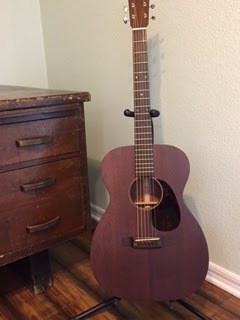
Which is why I bought a new guitar last week (at The Fret House in Covina). It's a Martin 00-15 mahogany beauty with tones so deep and resonant it nearly makes me cry when I play it. I spent weeks researching what I wanted, and with the help of a few old friends and some really cool new ones (thank you, Doug, Tom, Rick and Jorge!), I bought the guitar I've wanted all these years. (See photos below.) And oh Lordy, am I ever ready to make some new memories.


Tuesday, February 21, 2017

Where my heart wants to go


I suppose I've been a singer longer than I've been a writer. I started writing in the fourth grade, but I was singing from the time I was very small and very much under the influence of my older brother's albums by The Kingston Trio and Peter, Paul and Mary. We were a musical family. My father's Irish tenor voice was clear and beautiful when he sang "Irish Eyes" or "Too Ra Loo Ra Loo Ral." My mother had sung with a band here and there in her younger days, and I remember her singing show tunes—loudly—as she ironed our clothes or waxed the kitchen floor. My sister was really "the singer" in the family, taking on that role early and singing "Somewhere Over the Rainbow" in the elementary school talent show when she was in the fifth grade. Which is about the time I started writing. As the youngest of four children, I was the "shy" child (shouted down, more like), and writing allowed me to have some form of self-expression that was private and safe from my family's often brutal criticism and ridicule.

Music, though, shaped my identity. My friends in junior high and high school never knew about the stories I wrote, the journals I kept. But they knew I loved music in just about every genre from the Beatles to Motown to Johnny Cash and everything in between. I knew the lyrics to hundreds of songs.

So at fifteen, under my sister's tutelage, I learned to play the guitar. We went to the swap meet, and for $30 I bought a nice little folk guitar (which I kept until I gave it to my daughter on the occasion of the birth of her first child). I learned to play on that and was later given a "real" guitar, a steel-string higher-end Ibanez that I still play today.

When I play. Which is the problem. I don't play often enough to keep those calluses on my fingertips.

Back then, at fifteen, I played every day, singing folk songs and "Christian" songs my sister would teach me. (At that time, she was writing her own songs and would later go on to record an album with a Christian singing group.) When I was seventeen, someone tipped off a deacon in my church, and he asked me to sing a song before Bible study one night. I never did find out how he knew I could sing; I never sang in front of anyone. Ever. But I couldn't say no. Somehow it seemed like I'd be denying my gift if I did. So I said yes—and felt that heart-hammering-against-my-chest feeling for the first time in the moments before I began. There were several hundred people in the church that evening. I never really saw them. Once I began, I felt that transcendent power music has to take us to another place.

After that, I sang often. Eventually, I began to sing at weddings and funerals and odd celebrations. When I found myself married to the pastor of a church (see previous blog post), I sang at least once a week.

And then not at all for years.

When my husband and I separated, I lost every friend I had. My life became filled with raising our four children as a single parent while attending college full time. Occasionally I would get out my guitar and sing a song or two, but mostly I was doing homework or housework or child care, and the pleasure of sitting down to sing was a luxury I couldn't afford.

Once I started teaching, though, I had more time. And my kids were older. So once in a while I'd go out with Friend Laura to have a girls' night out and do some karaoke. Just so I wouldn't lose my ability to get up in front of people and sing. On one of those nights, I confessed to her my secret dream—to sing the National Anthem at a sporting event. Some months later, she called me, excited: Auditions were being held to sing the National Anthem at a Rancho Cucamonga Quakes baseball game. This required getting up on a temporary stage in the middle of the Montclair Plaza as people strolled by doing their shopping and belting out the song a cappella. Easy peasy. (Well, after a month of belting it out daily in the shower.) And with that, I was chosen.

The experience—for someone like me who has never taken singing lessons, never sung with a choir but is a patriot who absolutely loves flag and country—is humbling, to say the least. You stand behind home plate, your name is announced to the crowd (on the night I sang, two thousand people were in attendance), and someone hands you a microphone. And then you're on your own.

Yep, that's me!

I'm pretty sure I didn't embarrass the friends and family members who had come to hear me sing. I know for certain it was one of the proudest moments of my life.

Which led to me singing the anthem a couple more times (at pep rallies and a basketball game or two, since I taught high school), which then led to me singing in a few more weddings.

Mostly, now, I am focused on my writing, marketing what's already out there, working on new projects, big and small. And I don't think to get my old girl out of her case and just sit down and "let my music take me where my heart wants to go," as Cat Stevens put it. But I need to. My voice is my instrument, really (the guitar is just a prop), and my instrument has fallen out of tune, become weaker and less pure with lack of use. But music has always been my greatest comfort, and I need to keep it close.

So recently I volunteered to sing a couple of songs for a Valentine's Day luncheon. The performance was far from perfect. But it was a start.


Sunday, August 24, 2014


Last weekend I drove 34 miles to the Laemmle Theater in Pasadena because that was the closest theater showing the documentary Alive Inside. I'd heard about the film on NPR, and I knew from the clips and blurbs I saw and read online that I would love it. I did.

Here's the basic premise of the film: Provide era-specific music to dementia patients, then sit back and enjoy the miraculous result.

More specifically: Social worker Dan Cohen (upon whom I now have a pretty serious fan-girl crush), in doing volunteer work with the elderly and Alzheimer's patients, wanted to find a way to connect with those who seemed lost inside themselves. He recognized music as a powerful, evocative force which is universal in its appeal. So he filled up some iPods with music from specific decades, purchased a few sets of headphones, then invited a filmmaker to come along and document his attempt to reacquaint patients with the music of their childhood.

To say the resulting footage is profoundly moving would be an understatement. I knew this film would make me cry; the soundtrack of my own life includes all the pieces I have sung in church, in weddings, in funerals, at sporting events, in the shower, on horseback, on my bike, on a mountaintop, in my classroom and a thousand other places. My mama was a singer as was my sister, and my last good memories of my father before he died center around him singing—even as his life ebbed slowly away. But oh my lord, I first began to tear up just seconds into the movie. One minute past that, tears were streaming down my cheeks. Click here to see the story of Henry.

Dan Cohen's foundation, Music & Memory, is dedicated to bringing music to individuals with Alzheimer's and other dementias. What Cohen and others have found is that music stimulates memory in a positive and healthy way, and that it is far more effectual than medications and other traditional therapies for reaching dementia patients who have previously been unresponsive to treatment. Cohen devotes his time and energy to raising funds through Music & Memory in order to offer iPods and headphones to nursing homes across the country.

Alive Inside is an intensely personal film which depicts human kindness and tenderness in its most raw and authentic form. I came away changed, determined to spend a bit more time with my guitar—and also determined to try to help Cohen's vision reach fruition.

Find this movie and go watch it—even if it means a bit of a drive to get there. Then go hug your grandma (if she's still around). Then go to Music & Memory and make a donation. Then—and only then—sit down with your family and sing a few of your favorite songs. Because you still can.

Here's a link to a beautifully done trailer for the film. It's two minutes long but you may need multiple tissues to get through it:  Alive Inside trailer

Monday, November 11, 2013

What we no longer teach


In the course of my teaching day on Friday, two things were bothersome.

The first occurred when I read a poem with my Honors freshmen.  It’s a prose poem by Jack Gilbert entitled “Waiting and Finding" which appeared in   the July, 2013 issue of The Sun.  In it, the poet mentions a memory from his early school days, and in order to set up the poem for my students, I asked if they’d had the experience in elementary school of a teacher pulling out a box of instruments and distributing them to kids in the class to play as an accompaniment to group singing. A roomful of faces stared back at me in wonderment.  I shared with them my own experience of having a song book in my classroom desk each year of elementary school. Once a week—because it was part of the curriculum—the teacher would tell us to “get out your song books,” and for a half an hour or so, we would sing American folk and patriotic songs like “America the Beautiful” and “This Land is Your Land” and “The ErieCanal” and “Tingalayo.”   (Click on the song titles to listen to them on YouTube.) As we sang, kids used a wide variety of percussion instruments like maracas and tom toms and tambourines and cymbals and castanets to keep time and punctuate the cacophonous music we made, and for a shy kid like me, it was a chance to sing along without fear of being heard.

“Why didn’t we get to do that in elementary school?” my modern day students asked, and I nearly choked up in answering them.

“Because your teachers were busy preparing you for those all-important state tests,” I told them.  And I also told them, as I often do, that they are the next in line to rule the world, and as future school board members or school superintendents or state senators or governors, they can change things.  They should change things.

And also on Friday, I asked each class period of freshmen if they knew why they weren’t coming to school on Monday.
“It’s some holiday,” I heard in reply.
“Labor Day?” someone asked.
They didn’t know.

Telling them “Veteran’s Day” didn’t help.  They didn’t understand what it was for.  So I explained.  And then I had them write a brief paragraph on what it means to be a soldier.  For once, no one complained.  No one tried to waste time with questions or stall tactics.  They all simply began writing.  Because they all know someone who is serving or has served in some branch of the military.  And they wrote these amazing paragraphs about what it means to sign up for a job that might kill you or maim you or at the very least, require you to leave your family and friends and reside on foreign soil for long periods of time in uncomfortable conditions.


So I guess, yeah, they do really know what the day is for.  They just needed a moment to muse on it.