Showing posts with label reading. Show all posts

Wednesday, June 26, 2024

Who Is Matt Eicheldinger and Why Does He Make Me Cry Every Day?


Seriously, I don't know how his posts starting coming up in my Instagram feed, but suddenly one morning there was this earnest-looking dude holding a coffee mug, apparently sitting outside his house, and with a friendly wave he began a short chat with, "Hi, my name is Matt, I'm a teacher, and today's story is called...." I don't remember which story I heard first, but Matt already had me at "I'm a teacher...." Plus the coffee mug. Plus sitting outside. Plus... Well, you just have to hear the sincerity in his voice.

Anyway, Matt isn't just a teacher (although if that were his only gift, being the great teacher that he is--just listen to some of the stories from his classroom--we would be, as a society, super-blessed). He is also a terrific story teller. And a writer. And an artist. And now an author. But that's not why he makes me cry.

I mean, not yet. His books haven't made me cry yet. I will confess that as soon as I started seeing Matt's daily heartfelt, inspirational videos on Instagram, I became a full-on fangirl, so when Matt Sprouts and the Curse of the Ten Broken Toes released, I immediately bought a copy, read it, and reviewed it. Yes, it's a middle-grade book. So? I love children's literature (and I write it, so there's that). And it's the kind of book my youngest son would have absolutely loved when he was that age--lots of hijinks and mayhem and not much girlie stuff. So yeah, five star review for Matt Sprouts. Oh--and did I mention it has illustrations drawn by the author himself?

But as I said, that's not what makes me cry. Although Matt does have a book coming out soon entitled Sticky Notes that I'm pretty sure I'm going to have to read with a box of tissues next to me, such is the tender Irish heart in me.

Matt makes me cry nearly every day because he tells stories (often originating in his classroom, though some are lessons he's learned in life) that are simple and true. About kids learning how to be better humans. About kids demonstrating empathy. About kids who thought they failed but succeeded in coming away with a wider, wiser perspective. About striving as a teacher to get through the toughest days while still being kind and compassionate. These aren't smarmy stories. Mostly, they're touched with a bit of humor and Matt's goofy expressions as he mimics the way kids talk. (And they're spot on!) But his stories always have some take away, some thought-provoking message that touches my heart, reminds me of my best days teaching, and of course, brings me to tears.

In recent years, as I have learned to overcome that childhood sense of shame instilled in me for crying or exposing my emotions, I have been more open about how often I cry. (Daily. Sometimes hourly. I buy several boxes of Kleenex tissues--thank you, Kimberly-Clark--every week.) The way I figure it, I held back tears for decades, so there clearly must be an ocean full of tears just waiting for the tide to turn (coupla times a day, no?) to be released. Okay, maybe not an ocean. Maybe just the Salton Sea. But still.

So, as a storyteller myself, and wanting to leave you with some satisfying take away, I will (almost) end with this: Find Matt Eicheldinger and follow him. He's on Instagram and now Facebook. There are some YouTube videos. He's probably on Threads by now. (Isn't everybody except me?) Possibility Twitter, but I'm no longer a partner to those shenanigans, so I don't know.

Anyway, follow him. Get your daily dose of "we're gonna be okay" stories. Keep a tissue handy if you have any Irish or Italian in you. You can thank me later.

Addendum for readers who don't know me personally: This review of Matt's work is wholly unsolicited. I received no compensation for spending 45 minutes writing this when I could have been doing something fun like pulling weeds. In fact, by now Matt Eicheldinger probably thinks I'm stalking him because I feel compelled to comment on nearly every story he tells. (What can I say? I'm a writer; I can't help myself.) But... this is what I do. Like Madeleine L'Engle, Matt tried for years to get his first book published, but it wasn't like other books out there, so he had no takers. (Boy howdy, I've been there!) Truly, though, that first book deserves all the attention it's finally getting, and I'm here to help with that however I can. But also I love you (whoever you are), and I think your life might be enriched by Matt's storytelling. So get it. It's free. And it feels good. And who doesn't want that?  

Wednesday, January 12, 2022

Books in 2021


Some years ago, I began the habit of stacking up books in my to-read pile as autumn approaches. I hate the short days, when I can’t be outside as much, but if I have a book to look forward to reading, the long evening hours are well spent.

Here are a handful of books I’ve read in recent months that I absolutely loved.

Beautiful Ruins, Jess Walter

In a casual conversation, a somewhat happy-go-lucky friend mentioned that he had just finished reading a book that made him cry.

“What the heck? Really?” I queried. “What book was that?”

“Beautiful Ruins,” he responded. “Have you read it?”

“No,” I replied, “but I’m about to.” I downloaded it to my Kindle and started reading it that night. Why did I love it? For the characters. All of them, and there are many, therefore multiple points of view, but that is never off-putting to me. I want to hear everyone’s side of the story.

The Lincoln Highway, Amor Towles

This novel was also recommended by a friend who loves books and knows me well. It is similar to Beautiful Ruins in that there are multiple points of view, and most of the characters are easy to love, easy to sympathize with. The setting of this novel could have taken place in current times, but I’m so glad Amor Towles chose to set it in the 1950’s, the decade of my childhood. The writing is lovely, the characters so memorable and the book so long, a reader will genuinely miss them for days after finishing the book. I still do….

Project Hail Mary, Andy Weir

This novel is science fiction. But keep in mind, there is classic sci-fi, and then there are books like A Hitchhiker’s Guide to the Galaxy. Project Hail Mary isn’t quite Hitchhiker’s Guide, but it’s also definitely not Dune or The Martian Chronicles. Andy Weir, by the way, is the guy who wrote the novel The Martian, upon which the movie starring Matt Damon was based. I didn’t read that one. I only read Project Hail Mary because a friend sent it to me with a note saying “Trust me. Just start reading.” So I did, standing over my kitchen table, the cat still playing with the shipping debris. I read the first 20 pages that way, then made some lunch and sat down and read another 30, then realized the entire day was whiling away as I read this quirky, funny, harrowing, charming novel. I finished it in a matter of days (despite its length at 496 pages), then wrapped it up and sent it to a friend with a note that said, “Trust me. Just start reading….” He loved it so much he called me from Texas when he’d finished it. Our two-person book club spent an hour and a half talking about it. (Just to mention here: I rarely read sci-fi anymore, but I re-read Dune in the summer of 2021 because the absolutely fabulous film was set to air months later. Loved Dune even more the second time ‘round.)

A Valley of Light and Shadow: Las Vegas Writers on Good and Evil

In between novels, I read through the essays and memoir pieces in this anthology. The book is published in collaboration with the Las Vegas Book Festival, and it highlights the writing of authors who live or have lived in Sin City. In a conversation with my friend, the multi-talented Tim Chizmar, he mentioned he’d written an essay for the current volume. Since the proceeds of the book support writers, I bought a copy on Amazon, expecting to read a few essays about how, ‘Yeah, it’s hot here and there aren’t a lot of jobs besides working in the casinos.’ This book is definitely not that, and Tim’s essay was so compelling—about the profound life changes he went through over the course of a five-year period, how he hit rock bottom—then discovered he was headed for whatever was below rock bottom—then somehow survived, learned, grew, flourished and became successful all over again—well, it made me cry and applaud in equal measure. I highly recommend this book for lovers of human interest stories and also for my fellow writers; there are fine examples of the personal essay and memoir writing here, and money spent on the book will help support their craft.

The Sweetness of Water, Nathan Harris

Where do I begin? The sweetness of his words, the sweetness of his characters, the agony and sweetness of a time in our history…a time that somehow seems to keep repeating itself. This book is lovely in a thousand ways. I understand why Oprah snagged it for her book club, why Barack Obama said it was one of his favorite books of 2021. I’m right there with ya, Mr. President. If you love writers who can magically craft a sentence that stops you in your tracks for the sheer beauty of it—like a gorgeous sunset or the unexpected sighting of a wild animal—read this book. Then come weep with me.

Daughter of the Morning Star, Craig Johnson

Speaking of beautiful craftsmanship in writing, please never pigeon-hole Craig Johnson as simply a “mystery” writer or a writer of “Western” novels. The Longmire series definitely has a contemporary Western flavor, and each book has a stand-alone, mostly who-done-it mystery to be solved. But this series isn’t just beef & barbecue. It is rich in many sophisticated flavors as well. I began reading the Longmire series some years ago, based on the recommendation of a friend whom I trust—otherwise, I probably would have passed, assuming that the novels were gratuitous-violence-heavy and formulaic. No, in fact, they are not, and this was a delightful discovery. In fact, from the first pages of the first book, I was surprised and delighted by the extent of Craig Johnson’s expansive lexicon, his sensitive treatment of all things Native, and his extraordinary ability to weave a compelling story. I’ve read all the books up to this most recent one, but Daughter of the Morning Star is absolutely my favorite. Here’s why: In it, Johnson deals with a harrowing and heartbreaking truth, one that is astounding in its scope but shameful in its lack of coverage by the popular press. It is this: The suicide rate for Native teenagers is two and a half times greater than the national average, and the murder rate for Native women is ten times the national average. Every year, Native women go missing at a horrifying rate, but these cases rarely make the news. In Daughter of the Morning Star, Johnson dishes out these statistics unapologetically as he draws us into the life of Jaya One Moon, a rising high school basketball star. Native culture and beliefs are woven in with sensitivity (not appropriated), and we see in Jaya a woman whose great strength is no match for the dark forces that threaten her. Still, she perseveres. Another reader characterized this novel as haunting. It is exactly that. Hauntingly beautiful in its realism.


Sunday, July 26, 2020

Books, Part Two: Finding the Shadow of the Wind


Back in December, before Christmas, before the pandemic shut-down, in those chilly, blissful days when Dark Time came early, and I would hustle the cats inside to cuddle up and read with me, my book club made a donation of books—some new, some used—to a local group home that serves children who have been separated from their parents due to abuse. The residential facility, located on beautiful, sprawling acreage, was just getting its library reorganized after some renovation, so the books were greatly appreciated.
 
Most of the books were purchased new from money we’d collected in a bake sale, but we did have several boxes of books donated. A small group of members went through these donations, checking to be sure they were appropriate for children and teens, and also making sure the books adhered to the guidelines we’d been given by the group home: No dark subject matter, no gratuitous violence, no themes of death or dying or separation from parents. We ended up with a small box of rejected books that sat on my kitchen floor, just inside the door, until well after Christmas, New Year’s, and maybe even Easter, if I’m being honest.
 
My intent was to donate those books, a few at a time, to the Little Free Library I mentioned in my previous post. And I did. Every time I took a drive up to drop something off for Harry or his cat, Asher, I took another few books. Finally, there was one book left in the bottom of the box.
 
I pulled it out when I was getting ready to head up to Harry’s again, intending to put Sophie Quire in the library as well. But you know how that goes if you’re a bibliophile; we’re always curious. I flipped it over and read this on the back of the book:
 
Barcelona, 1945: A city slowly heals from its war wounds, and Daniel, an antiquarian book dealer’s son who mourns the loss of his mother, finds solace in a mysterious book entitled The Shadow of the Wind, by one Julian Carax. But when he sets out to find the author’s other works, he makes a shocking discovery: someone has been systematically destroying every copy of every book Carax has written. In fact, Daniel may have the last of Carax’s books in existence. Soon Daniel’s seemingly innocent quest opens a door into one of Barcelona’s darkest secrets—an epic story of murder, madness, and doomed love.
 
Intrigued (who wouldn’t be?) I opened the cover and read the first paragraphs:
 
    I still remember the day my father took me to the Cemetery of Forgotten Books for the first time. It was the early summer of 1945, and we walked through the streets of a Barcelona trapped beneath ashen skies as dawn poured over Rambla de Santa Monica in a wreath of liquid copper.
    “Daniel, you mustn’t tell anyone what you’re about to see today,” my father warned. “Not even your friend Tomas. No one.”
    “Not even Mommy?”
    My father sighed, hiding behind the sad smile that followed him like a shadow through life.
    “Of course you can tell her,” he answered, heavyhearted. “We keep no secrets from her. You can tell her everything.”
    Shortly after the Civil War, an outbreak of cholera had taken my mother away. We buried her on my fourth birthday. I can only recall that it rained all day and all night, and that when I asked my father whether heaven was crying, he couldn’t bring himself to reply.
 
And then, as the saying goes, I was hooked.
 
My desire to read the huge tome (of 487 pages in very small font) created a bit of a dilemma. If you are an avid reader who loves nothing more than to spend an afternoon browsing through a used book shop, please take a moment here to close your eyes and take a nice deep breath. As you exhale, thank the Universe (or whomever you would like) that you do not have a lung disease. Because if you were me, you wouldn’t be able to have that joy, that luxury, of walking through the aisles with row upon row of titles, pulling first this one, then that one off the shelf, loading up your arm or basket or bag with 5 or 6 or 10 because they’re priced at a dollar a book.
 
I can’t do that. Dust will kill me. Dust in books is really, really bad. And this book in particular was very, very old and very, very dusty. Just reading the first page started me coughing. So I did what I’ve learned to do in that situation. I put on the N95 mask I use for cleaning the house, took the book in the bathroom, plugged in my blow dryer, and blew the dust out while flipping through the pages. Works like a charm.
 
I’m so glad I did. Because when I finally started reading it, I needed it desperately. I needed its rich, dense prose, so carefully crafted, to lose myself in. I needed the twists and surprises of the plot to keep me turning pages. (I didn’t really need to be staying up past my usual bedtime every night, but that’s okay; I’m a grown-up. I have choices.) I needed to have that story to look forward to as cases of the virus continued to climb and the country went into lockdown and I couldn’t go to my book club meetings or have tea with friends or see my kids or grandchildren. In the days that I slowly made my way through it, savoring every page, that one author’s craftsmanship kept me from despair.
 
It's amazing how powerful books can be, isn’t it?


Sunday, July 19, 2020

Books, Part One: Rescuing Sophie Quire

Lately, my life has been fraught with drama, including an equal measure of bad and good news. News I can't talk about just yet. Some I'm excited about, some I'm downright ecstatic about (No, Ann, I still don't have a boyfriend), and some that is heartbreaking. My brain has been set on overdrive, fueled by frenetic energy, so it's been difficult for me to downshift long enough to write stuff. But I've been reading. Boy howdy, have I been reading. What would we all do without the escape of reading?

So in the next few posts, I want to talk about some of the books I've been reading. This is my favorite story about the stories, but I can't wait, so I'm sharing it first.

In the town directly north of mine, on a winding back road, there is a "Little Free Library." If you don't know about the Little Free Library project, click here for the back story. It's pretty amazing. The "library" pictured above is the one I mentioned. It's been erected at the side of the road I drive to get to my friend Harry's house in Cherry Valley.

Some weeks ago, while driving back from dropping off a few groceries for Harry, I came around the corner and saw a book lying in the middle of the road a few feet from the Little Free Library. Of course I pulled over and got out to pick it up; my bibliophile friends would be scandalized to see a book tossed out like that, like so much trash. I know I was. But I'm sure it was there by accident. Or was it?
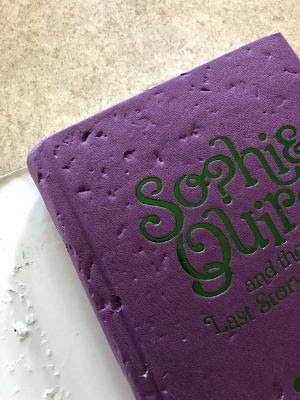
The title was Sophie Quire and the Last Storyguard. "Storyguard"? From the font and the whimsical picture on the book jacket, I could tell the book was children's literature. Of course I did what all book lovers do: I flipped it over and read the back cover. Not wanting to stand in the road and examine it further, but definitely wanting to read it, I tossed it on the floor of the car and drove off.

Upon my return home, I promptly forgot about it, and it remained in the car for quite a number of days (because, you know, the pandemic and all; no one's going anywhere much). Finally, I remembered it and brought it into the house.

Mystery #1: When I rescued it, the book had been lying in the southbound lane of traffic. The Little Free Library is on the opposite side of the road, and it has been sturdily built, with a door that closes tightly. I mean, it's not like the book fell out. And the paper book jacket wasn't torn or dirty, as it might have been if it had fallen from a car and slid along the pavement. It was as if someone had intentionally dropped the book smack dab in the middle of the road.

Mystery #2: There was, however, damage to the jacket--and not the unintentional sort. The jacket was riddled with holes. When I pulled it off to examine the actual cover of the book, I could see many, many punctures.

It looked as if someone had gone after the book with an instrument such as a pen, jabbing it over and over and over on the front, on the back, and even along the spine.

What the heck?? Who does this to a book?? What's the opposite of bibliophilia? (Let me know if you discover an antonym; I did not in my quick search just now.) Did this book's attacker dislike the main character? Or the ending? Or the fact that he/she/they had been forced to read a book?

I'm struggling to live with my unsatisfied curiosity, but alas, chances are I will never be able to solve those two mysteries.

What I can tell you, though, is that the book was delightful. Here's part of the description from Amazon.com:

"Sophie knows little beyond the four walls of her father's bookshop, where she repairs old books and dreams of escaping the confines of her dull life. But when a strange boy and his talking cat/horse companion show up with a rare and mysterious book, she finds herself pulled into an adventure beyond anything she has ever read."

Cool, huh? And yes, that does say "cat/horse companion." I don't want to give any spoilers away, but the book is filled with fantasy and whimsy and adventure--and a few very tense scenes. Oh, and a very strong female protagonist.

I loved it, loved the premise, the solid storytelling, the narrator's at times snarky voice, and I loved that the heroes were children.

I know you want to read it now, and I would loan you my copy, but as soon as I finished it, I dropped it off at the Little Free Library in Cherry Valley. I hope it's not languishing there. I hope some young person, intrigued by the brightly painted red and white stand, pulled it out, read the back cover and maybe the first page, and decided to take it home.


Sunday, February 21, 2016

In Memoriam: Harper Lee


In 1966, desperate to find a book to read, I snuck into my brother’s room when no one was home and browsed through the books in his closet. I don’t know what made me choose To Kill a Mockingbird, but I do remember that once I began, I couldn’t put it down. I was twelve years old.

Two years later, the movie starring Gregory Peck (and the inimitable Robert Duvall as Boo Radley) aired on television, and all the characters I had fallen in love with came to life in black and white. That same year, men who had become my heroes in the Civil Rights Movement mostly because of my reading of the novel—Bobby Kennedy and Martin Luther King, Jr.—lost their lives to the socio-political war that was devastating the country at that time.

To say this novel shaped my life is an understatement. I lost my father at a young age and was raised by a non-nurturing mother. Like so many others who’ve read this book, I both envied and longed for the type of strong, loving relationship Scout shares with Atticus. And I yearned for the wisdom of Atticus in my life.

When Atticus looked down at me I saw the expression on his face that always made me expect something. “Do you know what a compromise is?” he asked.

And I learned volumes about parenting from his example:

I had spent most of the day climbing up and down, running errands for [Jem], providing him with literature, nourishment and water, and was carrying him blankets for the night when Atticus said if I paid no attention to him, Jem would come down. Atticus was right.

This was such an important book in my life that when my own daughter turned twelve, I bought her a copy—and I ended up re-reading the novel from start to finish, falling in love with Atticus even more, now that I was a parent myself.

By the time my daughter was a teenager, I had become a teacher. In my second year of teaching high school, I was assigned freshman English. That year we read To Kill a Mockingbird together, and for twenty-five out of the twenty-seven years of my teaching career, I have read it again—mostly aloud, affecting a Southern accent, and always, always fighting back tears in certain sections:

“Miss Jean Louise, stand up. Your father’s passin’.”

“Hey, Boo.”

“Mr. Tate was right.”
Atticus disengaged himself and looked at me. “What do you mean?”
“Well, it’d be sort of like shootin’ a mockingbird, wouldn’t it?”
Before he went inside the house, [Atticus] stopped in front of Boo Radley. “Thank you for my children, Arthur,” he said.
(Gregory Peck’s line in the screenplay version is, “Thank you, Arthur. Thank you for my children,” as he extends his hand to shake Boo’s. To my mind, it is one of the simplest yet most beautifully moving scenes in the film.)

He turned out the light and went into Jem’s room. He would be there all night, and he would be there when Jem waked up in the morning.

In my early years of teaching, I was sometimes criticized for readingewwww aloud to my students. (‘They’re in high school now. They need to learn to read and comprehend on their own.’) To my way of thinking, these folks had it all wrong. What better way to learn to comprehend the dynamics of literature than to hear the words come alive? Hearing someone who is familiar with the text stream through the long sections of dialogue in the courtroom scene has to be better than trying to parse through Tom Robinson’s style of speech (“No suh, I’s scared I’d be in court….”) while keeping track of who was speaking and what significance there was in the sometimes calm, sometimes accusatory exchange of questions and answers.

Because I read the novel along with my students, I’ve read it in excess of a hundred times. Each spring I read it with a new batch of kids, and each time I learn something new. It took me years to figure out why Harper Lee included the chapter on Mrs. Dubose—because as a writer, I know that every chapter has a purpose, but for the life of me, I couldn’t figure out how Mrs. Dubose supported the theme of the novel. Until I realized what she stood for. And then the epiphany came like a bolt of lightning.

“You know, she was a great lady.”

Yes, Atticus, just as the pre-Civil War South was, and it, too, suffered from a disease that ravaged it.

Over the years, as I’ve taught Mockingbird, I’ve thought fondly of Harper Lee. She would have been in her sixties when I first began teaching the novel. After I’d been teaching it for several years, I wrote her a long letter, never expecting any response, just wanting her to know how meaningful the book had been to me as a child and as an adult. She never answered, but this was her way, and everyone knew it. As the years went by, I would occasionally seek out her name on the internet to see how she was faring. Every year I’ve been able to tell my students as we finish the novel, “So Harper Lee is still alive…” (because 1960, the year the book came out, seems like hundreds of years ago to them). As it turns out, we are currently reading the book in my class. Tomorrow in each class period, I will tell them that Harper Lee has died, and we will talk about the legacy she has left behind.

Lee’s Pulitzer Prize winning novel helped solidify the Civil Rights Movement in America. Since its publication, it has never been out of print. Countless generations of readers, old and young, have found friends and role models in Jem, Scout, Dill, Atticus, Calpurnia, Miss Maudie, Tom Robinson and the rest of the characters. The novel will continue to influence readers for generations to come.


Rest in peace, Harper Lee. Thank you for your life, thank you for your work, thank you for your heart. Your words will be with us forever.


Monday, February 15, 2016

Sustenance


Today’s blog post is dedicated to my long-time friend, Barbara Tinsley. A score of years ago or so—when our grandchildren were children—Barbara was a regular reader of one of the papers in the City News Group trio, and she became a fan of my weekly column. Over the years, we’ve had great conversations about life, kids, grandkids, and other joys. Her official duty as the unofficial president of my fan club is to poke and prod me when I neglect my blog (which has now taken the place of my weekly column). Thank you, Barb, for your friendship, which is so dear to me, and Happy, happy birthday!

People have asked if, when I retire, I’ll still get up at 4:00a.m. No. Absolutely not. I’m planning on sleeping in until 5:00 or maybe even as late as 5:30. Because “we were meant to see the beginning of the day/Ibelieve it was planned to lift us this way.” And because the best quiet time to write is before my head is filled with the daily news and dire predictions. I still won’t use an alarm clock (as I do not now), and I will still spend the last moments before I drift off with nothing electronic going except a soft bedside light—to illuminate the pages as I read myself off to dreamland. Here’s what I’ve been reading lately, in no particular order of love:

Plainsong by Kent Haruf. If you read novels for the sheer joy of discovering characters, read this book. I tried to read it slowly as it is not terribly long, and I fell in love with the characters so immediately, I never wanted it to end—and when I finished, I couldn’t start another book as I missed my newfound friends. Love, love, loved it. I want every reading friend to read this book, and I might have to guilt some people into it. (Barb, I put this one first as I really think you would love it.)

Ordinary Grace, by William Kent Krueger. See the description above, and add a couple of murders and a plot twist or two. If you’re sharp and you read a lot of mystery, you’ll connect the dots before the intense climax, but that doesn’t really matter to this novel; it’s all about the characters. My bestie Donna sent this novel to me as a sweet gift, and I loved it so much I don’t think I can ever repay her.

Millersburg, by Harry Cauley. I am proud to say that actor, writer, director Harry Cauley is my friend, and we became friends because, well, I was a gushing fan girl over his novel, Bridie and Finn, and his memoir, Speaking of Cats. When I finished Plainsong, I dropped it off with Harry because I knew he would love it, and we subsequently had a phone conversation or two about it (Harry agreeing that it is “just lovely”). When I started Ordinary Grace, I remarked to him that it was similar to Plainsong, but with murder, and he replied, “That sounds like my novel, Millersburg.” How did I not know of this other novel of Harry’s? I hit Amazon immediately upon hanging up the phone. So once again, see the description above. Yes, there are two murders that occur, but the novel isn’t about them. Its subject is the people whose lives surround the circumstances of the murders, and it is Harry’s inimitable style and grace that makes this little book so satisfying. Again, I didn’t want it to end. (Harry also had a birthday this week. At 85, he is still writing up a storm, and I am the one who pokes and prods him to finish another novel because I just love his writing.)

The Buried Giant, by Kazuo Ishiguro. I would not have come to this book were it not for my book club. (Bless you, ladies.) If you’re a reader of great fiction, you may recall that Ishiguro is the author of The Remains of the Day (from which the screenplay was adapted). This book is nothing at all like that one. This book…. Oh, shoot, I don’t even know how to describe it. This book is imaginative fiction in its most brilliant and haunting form. Ishiguro, truly, is a genius, and is considered one of the greatest contemporary British novelists. (He was born in Japan but grew up in England.) This novel, to me, is an allegory—of sorts. And I really don’t want to comment further, other than to say there is an amazing storyline here… and ogres… and pixies… and dragons… and, of course, the buried giant. Here are my two favorite passages:

[King] Arthur charged us at all times to spare the innocents caught in the clatter of war. More, sir, he commanded us to rescue and give sanctuary when we could to all women, children and elderly, be they Briton or Saxon.

We must hope God yet finds a way to preserve the bonds between our peoples, yet custom and suspicion have always divided us. Who knows what will come when quick-tongued men make ancient grievances rhyme with fresh desire for land and conquest?


These books have sustained me in recent times. It is always heartening to know that, whatever calamity befalls me in the course of a day, at long last—in the remains of that day—I will rest upon my bed, a cat on either side, a dog nearby, and immerse myself in the brilliant stories of others. That, indeed, is lovely.

Sunday, August 23, 2015

Go Set a Watchman


Atticus Finch is not a real person. He is a character in a novel. While he may be multifaceted and dynamic as a character, he is that and only that—a character, comprised of the requisite parts given him by Harper Lee when she wrote the consummate American novel, To Kill a Mockingbird and also when she wrote the first draft of that novel, which is now known as Go Set a Watchman.

For in fact, that is exactly what Go Set a Watchman is—a first draft, the initial disorganized and somewhat plotless musings of a slightly younger Harper Lee than the one who wrote Mockingbird. Miss Lee's publisher, HarperCollins, has done the business of promoting Watchman as if it were an entirely separate novel—because that is what their identity is; they are a business. As much as we would like to think of publishing houses as being run by noble, educated persons who are nearly super-heroes in their defense of great literature, the truth is, HarperCollins is a business organized for the purpose of making money. Lots and lots of money.

And so it seems they have done with Watchman. (It is currently number one in literature/classics on Amazon.) But while they touted this book as 'a new novel by Harper Lee,' those good folks know exactly what this is; it is the first pages of a novel written by a young college student who thought she might like to write about the South, her hometown, and her father. In Watchman, she characterizes Atticus as having caved to the agenda of the racists of his town. In Mockingbird, he stands against such folk. Which Atticus best reflects Amasa Coleman Lee, Harper's real-life father? Who can say, and we will never know, as our beloved Miss Lee, always reticent to give interviews, is now beyond the point of discussing either novel.

When I wrote Tainted Legacy, a book about my great-grandmother, Bertha Gifford, who is now vilified as a serial killer, I wrote the original draft to fit the current True Crime genre. After long discussions with a publisher who read that original draft, however, I decided to rewrite the book as a memoir. Now it is a book that I am quite proud of, as it reflects a wider scope of Bertha's story (which is also my grandmother's story and my mother's and mine as well). In the same way, I believe Harper Lee had similar discussions about her first go at a novel, and she came away with some ideas about how she wanted to change her portrayal of this character, Atticus Finch, and the town of Maycomb... and herself. Thus she produced the much beloved work we know today as Mockingbird. If only she'd had the presence of mind to toss that first manuscript in the incinerator... as I have done with my first attempt.


Sunday, July 22, 2012

Books, Dogs and HOPE


Forgive me for being absent from posting for a while.  I’ve had my writer’s hat on, certainly, but my time has been spent, in recent days, working more on the business side of the craft than on the creative side.


I’ve got some great news flashes I’ve been wanting to share with you, Dear Reader, but first let me describe where I am—because I really can’t write a blog post without talking about the mountain.  I know you understand….


At the beginning of the summer, I bought an inexpensive HP laptop so that I could do this:  I’m sitting in the swing on the front deck.  It’s about 3:00 in the afternoon.  A light breeze is blowing through the oak tree canopy surrounding the cabin, cooling my skin and mimicking the sound of water rushing over rocks in a faraway stream.  Punctuating that sound is the chatter and call of some  bluejays, chickadees, wrens, woodpeckers, dark-eyed juncos, a titmouse or two, and something that sounds like a guinea pig making its “week-week-week” sound.  Sugie hears them, too.  She’s sprawled out in the dappled shade a few feet from the swing pretending to relax, but she is ever-vigilant.  Beware, my feathered friends; do not land too close.


So.  Part of what has kept me busy in recent weeks has been writing book reviews.  Some writer friends have had books released (hurray!), and summer gives me (too much?) insouciant time to sit as I am now, enjoying the outdoors while turning pages.  (It’s okay to be envious; that will all change in winter when it’s snowing and the swing is packed away in the garage.  Of course, then I’ll be sitting in front of the fire….)

Libby Grandy, a long time blogger and Chicken Soup author, has seen the release of her first novel, Desert Soliloquy.  I was privileged to read it in manuscript form, but the book had been so diligently edited I really didn’t have much of a critique to make.  I love a good mystery, and this one is tightly woven.  She does not go over the top with red herrings (hate that), but keeps the suspense taut—not only with the mystery of the attempted murder but also with the deeper, perhaps more mysterious question of who the protagonist will choose to spend her life with.  Loved it—and hate the fact that Libby has a second novel nearly ready for publication but feels inclined to wait until next summer for its release.  But I want to read it nowwwww.

Paula Priamos, also a blogger and a professor of all things literary, just saw the release of her memoir, The Shyster’s Daughter.  I’ve been waiting for this book for nearly two years, ever since Paula’s husband, author James Brown (The Los Angeles Diaries), bragged about it at a writers conference.  I have to warn you, if you read memoirs because you enjoy reading light-hearted tales told by upbeat people who managed to keep smiling through hard times, better buckle your seatbelt for this one.  Priamos’ writing is stark and tight and gripping.  And geez, does she ever have a story to tell about growing up in SoCal with her high-profile attorney father, an inappropriate uncle, and other characters guaranteed to ensure a kid’s quick loss of innocence.  I had kind of a weird, schizophrenic response to the book as I read it; I’d read a few pages, mutter “oh my god” out loud, put the book down because it reminded me far too much of my own childhood, then pick it up and start reading again.  It’s the most compelling memoir I’ve read in years.


Since I’m talking books, please indulge me for a moment.  The Kindle version of MartinLastrapes’ book, Inside the Outside, made it all the way to Number One on Amazon’s Horror list a few weeks back.  As you may know (because I seem to mention it often), Martin was a student of mine way back when I taught English 1A for Chaffey College.  All I said was, “Martin, you could be a writer,” and look what the kid did.  Geez….


Finally (and can I have a drum roll here, please?), my memoir, The Dogs Who Saved Me, came out this month.  I want to shout “Hurray!” in jubilant celebration… but I think I’m still recovering from writing this book.  I was so cavalier two summers ago when I began work on this project.  “I’ll just write about my dogs!” I thought.  “Easy peasy!”  No.  This was the most challenging writing task I’ve ever assigned myself.  Little did I know how tough it would be to recall those dark adolescent days and other points in my life in which I needed the unconditional love of a dog to sustain me.  Now, though, I’m glad I kept trudging through it (with frequent breaks, I kid you not, to simply walk away from the keyboard, out into the forest, to let the tears fall until I could breathe normally again).  My intent with this book is to honor the dogs who quite literally saved my life.  I think telling their stories does that.  But… to honor them further, I’ll be donating all the royalties from this book to animal rescue.  The first royalty check will go to HOPE rescue in Upland, California.  HOPE is comprised of a tiny crew of amazing and selfless people who work tirelessly to rescue dogs and cats slated for euthanasia or that have been found on the streets.  My little Sug was just such a cat, taken in by HOPE, placed in foster care where she was loved and spayed and brought to good health, then made available for adoption.  Had she gone to a public shelter, she would never have made it out alive.  And what would I do without her?  Recently the good folks at HOPE rescued a beautiful Beagle mix puppy from a high-kill shelter and a volunteer is now fostering her.  I love these peeps, so every time someone buys a copy of Dogs, I get all happy, because I know that the royalty from that sale will enable HOPE to do just a bit more of the heroic work they do.


So you can see why I’m busy trying to promote this book.  I’ve set up some readings/signings, which I’ll be announcing here.  I always love doing these events (what author doesn’t?), but they’re especially fun when I know that the end result will enable me to contribute to the fur community.  Win!  Win!  Win!  

Sunday, June 10, 2012

Death of an Icon

Losing Ray Bradbury from this world is like being told that hot fudge sundaes have ceased to exist and I will never have the experience of eating one again in my life. Losing his creative and imaginative writing, his brilliant and adoring words, is tantamount to losing something that is both tangible and visceral. Great writers die and their works live on, but Bradbury’s presence and persona imbued him with a god-like aura, I think because wherever he went, he simply oozed joy and love and enthusiasm.
During the science fiction phase of my young adulthood, I read and loved The Illustrated Man and The Martian Chronicles. In college, first one professor then another told me Bradbury stories. This man who loved the idea of dinosaurs and time machines and rocket ships refused to drive cars or fly in planes. He was a hopeless romantic. He loved everyone. He swore like a sailor. A prof at UCR had us read a short story by Bradbury in which he reverses history (with the deployment of a time machine) and Ernest Hemingway does not blow his brains out with a shotgun. My hero.  (For time travel enthusiasts who ascribe to the "butterfly effect," please note that the term was coined from Bradbury's short story, "A Sound of Thunder.")

Though he traveled the world (and especially adored Paris), Bradbury loved living in Southern California and agreed to countless speaking engagements here. When he came to speak at nearby Chaffey College, my friend Lana and I went to see him. We arrived an hour early and sat in the front row. Though mesmerized by his often shouted remarks (“I love America! I love the freedom of our democracy! If you don’t like the sons-a-bitches, you can vote them out and vote the bastards in! And if you decide you don’t like the bastards, you can vote them out and vote the sons-a-bitches back in! It’s wonderful!”), I did have the presence of mind to notice him take one sip from a tall glass kitchen tumbler that had been placed on his lectern. Afterward, as the auditorium cleared, I told Lana I wanted to take it, but I’d never stolen anything before, so I was deeply conflicted. Just then a stagehand appeared to clean up, and I asked him if I could have the glass if I promised to replace it. He handed it to me. It sat on the highest shelf of my kitchen cabinet for a year—until Lana’s daughter dragged it down to get a drink of water, dropping it in the sink, where it shattered. Nothing lives forever….

In the fall of 2010, I saw Bradbury speak at the Duarte Authors Festival. Wheelchair bound, he was frail and attended by several handlers. But he had lost none of his enthusiasm. He told story after story of living life as a writer, admonishing the crowd repeatedly to “love each other, love everyone.” That was how he lived his life.

Geez, Ray, a light has gone out down here. But… I’m curious. What are you doing now? Smoking cigars with Hemingway? Buzzing around from planet to planet? Riding on the backs of dinosaurs? Enjoy yourself. It’s going to take me the rest of my short time here to read what I haven’t yet read of your life’s work. May I be so prolific, so imaginative, so original in my own writing. Farewell for now, my friend.